TL;DR
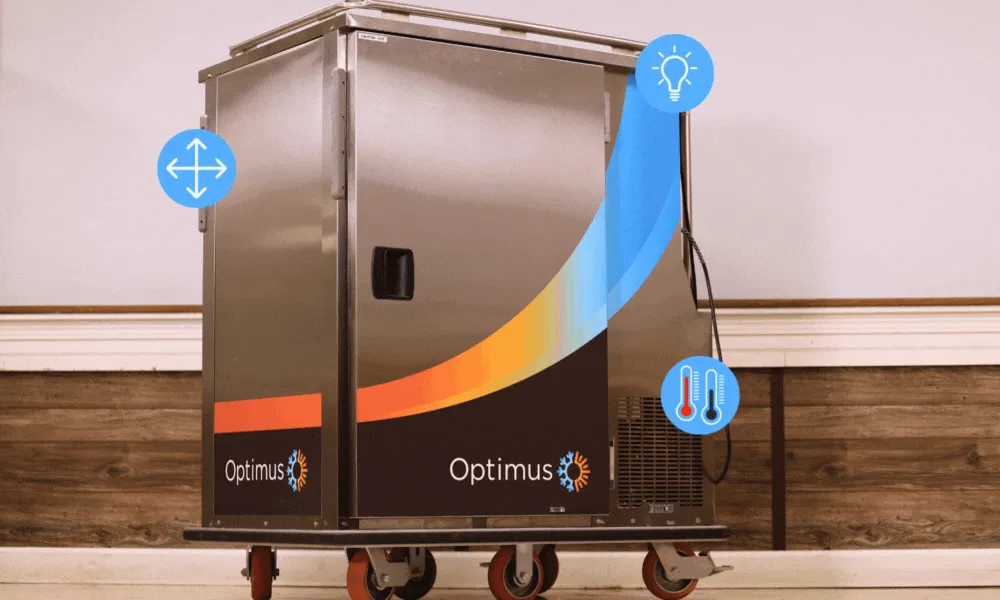
Optimus is a compact hot/cold meal delivery cart for hospital tray service, room service, late tray scenarios, and long-term care. Active heating and active refrigeration run simultaneously on one tray. Plugs into a standard 120V/20A outlet. 30-day USB temperature logger built in. No docking station. Made in West Lafayette, Ohio.
Why Facilities Choose Optimus
No docking station
Plug Optimus in. Walk away with the cart. No 208V wall unit, no docking nest, no infrastructure retrofit.
Simultaneous hot + cold
Side-mounted refrigeration on one side; convection heat on the other. Both run continuously while the cart is in motion.
120V / 20A standard circuit
NEMA 5-20P plug. 14A actual draw, 1400W. Same outlet your kitchen already has. No 208V three-phase install required.
30-day USB temperature logger
Built-in USB logger captures hot- and cold-zone temperatures continuously for up to 30 days. Supports HACCP documentation.
Optimus ONE-20 Verified Specifications
Figures from the JZHR-ONE-20 spec sheet. ONE-22 and ONE-24 capacity configurations are also available — contact JonesZylon for current per-model specifications and spacing options.
| Capacity | 20 meals (10 per side, 4" tray spacing) |
|---|
| Tray dimensions | 23.5" × 12.5" × 0.5" |
|---|
| Cart dimensions (H × W × D) | 56.5" × 51.25" × 32.0" |
|---|
| Weight | Under 430 lbs (ONE-20) |
|---|
| Power | 120V / 20A circuit (NEMA 5-20P) — 14A / 1400W actual draw |
|---|
| Exterior | 18-gauge stainless steel |
|---|
| Frame | 16-gauge stainless steel, reinforced cross channels |
|---|
| Doors | Auto soft-close + hold-open · antimicrobial handles |
|---|
| Casters | Six 6" premium casters |
|---|
| Controls | Touchscreen · preset temps · timed start |
|---|
| Data logging | 30-day USB temperature log |
|---|
| Certifications | NSF and Intertek listed |
|---|
| Origin | Made in USA (West Lafayette, OH) |
|---|
Replacing Pellet Systems
A pellet base system has three pieces: a wax-filled pellet heated in a charger, slipped under the plate, and topped with a heated dome. The whole stack travels with the meal on an insulated transport cart. The charger queues at peak service, pellet thermal performance degrades silently over time, and cold zones don't exist — the insulated cabinet slows but doesn't stop warm-up of cold items.
Optimus replaces the pellet system with active heating on one side of a center wall and active refrigeration on the other. No charger queue. No pellets. No domes. Cold food is now actively refrigerated rather than relying on cabinet insulation. Trayline labor drops because the per-tray steps go from five to two: load tray and close cabinet.
Most facilities migrate in phases — pilot one floor or one shift, validate, then expand. Read the full pellet replacement guide for the spec-by-spec narrative and switchover playbook, or compare pellet versus heated and refrigerated in a side-by-side table.
Replacing Docking Stations
Aladdin Convect-Rite-style architectures pair an insulated cart with a wall-mounted docking station running 208V/30A three-phase power. The cart docks at the floor unit, runs a 45–60 minute retherm cycle, then undocks for delivery — holding insulated temperature for roughly 45 minutes after disconnect. The docking stations are stationary and required in every floor pantry where a tray gets thermally finished.
Optimus is a self-contained 120V cart. There is no wall unit, no docking nest, no retherm cycle. Hot food was hot when it left the kitchen, and the cabinet keeps it hot during transport. The geographic flexibility scales with the cart count, not the station count: one Optimus can serve cardiology, oncology, ICU, LTC, or behavioral health on the same day, plugged into whatever 120V/20A receptacle is closest.
Docking vs self-contained walks through the operating-model differences. 120V vs 208V power planning covers the electrical infrastructure side of the decision.
Active vs Passive Holding
Passive insulated holding cabinets — Cambro Camtherm, classic insulated tray carts — slow temperature change but don't reverse it. Hot food cools, cold food warms, and the rate depends on cart insulation, ambient conditions, and how often the doors open. For short-distance dining-room transport this is fine. For unitized hospital tray service over 30–60 minute service windows, passive insulation drifts cold items into the danger zone.
Active hot/cold cabinets actively heat one zone and actively refrigerate the other, simultaneously, on one tray. Hot food stays hot because the cabinet is heating it. Cold food stays cold because the cabinet is refrigerating it. The temperature record is something the cart produces, not something staff sample with a clipboard.
Hot/cold meal delivery cart architectures explains the three architectures (passive insulated, switch hot OR cold, simultaneous active hot+cold) and which workflow each fits.
Optimus FAQs
Does the Optimus plug into a standard outlet?
Optimus runs on a 120V / 20A circuit using a NEMA 5-20P plug. Most hospital and senior living kitchens already have these. Actual draw is 14A / 1400W.
Can the Optimus run on a 15-amp circuit?
No. Optimus requires a 20A circuit. The plug is NEMA 5-20P (the T-slot 20A configuration). Do not run it on a 15-amp circuit. More on power planning.
How does Optimus keep hot food hot and cold food cold on the same tray?
A center wall separates the cabinet into two active zones. Side-mounted refrigeration runs on one side; convection heat on the other. Both run continuously while the cart is plugged in or in motion. Active hot/cold deep dive.
How many meals does the Optimus ONE-20 hold?
The ONE-20 holds 20 meals — 10 per side, at 4-inch tray spacing. ONE-22 and ONE-24 capacity configurations are also available; contact us for current per-model specifications.
Is the Optimus a rethermalization cart?
No. Rethermalization carts re-heat pre-cooked, refrigerated food to serving temperature, usually inside a docking station. Optimus is an active hot/cold delivery cart — it holds already-prepared hot food hot and cold food cold during transport. What is rethermalization?
Does the Optimus require a docking station?
No. Optimus is a self-contained cart. There is no wall unit, no base station, no nesting infrastructure. Plug Optimus into a standard 120V/20A outlet and roll. Docking vs self-contained.
How does the 30-day USB temperature logger help with HACCP?
The built-in USB logger records hot- and cold-zone temperatures continuously and stores up to 30 days of data. Pull the file for surveyors or internal audits. This supports HACCP documentation; the cart itself is not HACCP certified — HACCP is a process, not a piece of equipment. HACCP documentation guide.
Is the Optimus made of stainless steel?
Yes. The exterior is 18-gauge stainless steel. The frame is 16-gauge stainless with reinforced cross channels. Door handles are antimicrobial.
Where are Optimus carts made?
Optimus carts are designed and built in West Lafayette, Ohio, by JonesZylon. Made in USA.
Related guides:
All Meal Delivery Carts ·
Hot/Cold Meal Delivery Carts ·
Pellet System Replacement ·
What Is Rethermalization? ·
Docking vs Self-Contained ·
120V vs 208V Power Planning ·
HACCP Documentation ·
FAQs